
Linha de enchimento Gai 753 A-ISO-001


 Rougemont

Se decidir comprar equipamento a baixo preço, certifique-se de que contacta com o verdadeiro vendedor. Obtenha todas as informações possíveis sobre o proprietário do equipamento. Uma das formas de enganar potenciais clientes consiste em apresentarem-se como uma empresa real. Caso tenha suspeitas, informe-nos sobre as mesmas, para que possamos proceder a controlos adicionais, através do formulário destinado a transmitir comentários e opiniões.
Antes de efetuar uma compra, analise atentamente vários ofertas, para ter uma ideia do preço médio de venda do equipamento que escolheu. Se o preço da oferta que mais lhe agrada for muito inferior ao de outras ofertas idênticas, desconfie. Uma diferença de preço significativa pode indicar defeitos ocultos no equipamento ou uma tentativa de cometer atos fraudulentos por parte do vendedor.
Não compre produtos cujo preço se afaste marcadamente do preço médio de produtos similares.
Não efetue pagamentos por conta nem adquira produtos pré-pagos duvidosos. Em caso de dúvida, não receie pedir esclarecimentos e fotografias e documentação adicionais do equipamento, verificar a autenticidade de documentos e fazer perguntas.
É o tipo de fraude mais comum. Vendedores desonestos podem pedir um pagamento por conta ou sinal para assegurar a "reserva" do equipamento. Desta forma, os falsos vendedores podem conseguir um elevado montante e desaparecer, deixando de contactar os compradores e ficando incontactáveis.
- A realização do pagamento por conta com cartão
- Não efetue qualquer pagamento por conta sem documentos que confirmem a transferência do dinheiro, caso tenha dúvidas sobre o vendedor.
- A transferência do pagamento por conta para a conta do “administrador”
- Um pedido desta natureza deve alertá-lo, pois é muito provavelmente sinónimo de que está a negociar com um burlão.
- A transferência do pagamento por conta para a conta de uma empresa com o mesmo nome
- Seja cauteloso, os burlões podem utilizar nomes de empresas muito conhecidas, aos quais introduzem alterações quase impercetíveis. Se tiver a menor dúvida quanto ao nome da empresa, não efetue qualquer transferência.
- A substituição de dados na fatura de uma empresa real
- Antes de efetuar uma transferência, certifique-se de que os dados indicados estão corretos e que correspondem à empresa especificada.
 +1 450-618...
Mostrar
+1 450-618-0522
+1 450-618...
Mostrar
+1 450-618-0522


 Espanha, Barcelona


 Alemanha, Menslage


 Alemanha, Burgwald-Ernsthausen


 Alemanha, Burgwald-Ernsthausen


 Alemanha, Menslage


 Espanha, Barcelona


 Alemanha, Menslage
 Alemanha, Metten


 Alemanha, Menslage


 Alemanha, Burgwald-Ernsthausen


 Alemanha, Burgwald-Ernsthausen


- Filling system: Rotary Isobaric (for carbonated beverages – can also be used for still products)
- Rinser heads: 9
- Filling heads: 8
- Revolving capping head: 1 (2 sizes)
- Capacity: 1500 bottles/hour (355 mL) and 900 bottles/hour (750 mL)
- Current bottle formats: 355 mL and 750 mL (other bottle format can be added)
- Closure type: Crown caps (26 mm and 29 mm)
**Overview**
The GAI 753 A ISO monobloc is an automatic electropneumatic isobaric filler, designed by GAI France. Optimized for still or carbonated products (beer, wine, cider, water), it integrates rinsing, filling, and capping on a single frame.
Main features:
- Technology: Isobaric with patented electropneumatic valves FILLING - Quality Wine.
- Versatility: Ideal for oxygen-sensitive liquids, handles vacuum and CO2 perfectly.
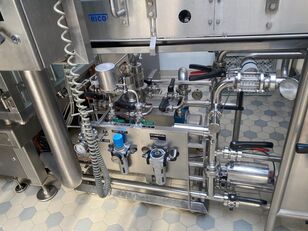
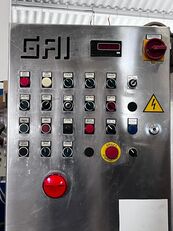
This glass bottle filler and capper was manufactured in 2013. The 753 A ISO model is a compact and precise filling monoblock designed for small to medium-sized beverage producers. It features an automatic height adjustment for easy format changes. With a capacity of up to 1500 bottles (or 500 liters) per hour, the unit is suitable for bottles ranging from 0.25 L to 1.0 L. The machine is in excellent condition and ready for operation. All maintenance has been performed by GAI-trained technicians.
**Technical data**
- Stainless steel construction
- The filler valves feature bottle vacuum, self-levelling, and de-gassing.
- Vacuum circuit for minimal oxidation during bottling.
- Easy to sterilize using either chemical products or steam.
1) The capacitive sensor precisely adjusts the level of the liquid in the tank, controlling the feed pump inverter.
2) The pressure switch precisely maintains the pressure in the tank, controlling the gas inlet and pressure outlet solenoid valves.
3) The filler valve with three small pistons includes:
a) De-aeration of the bottle
b) Self-levelling with gas injection
c) Gradual degassing of the bottle.
4) The vacuum and gas injection circuits are built into a flange mechanically joined to the filler tank. This solution makes sterilization of these circuits easy and secure.
5) The central bottom infeed of the liquid is ideal because it:
a) Minimizes oxidation
b) Reduces the formation of froth
c) Facilitates cleaning and sterilization of the tank.
6) The large-section vacuum piping allows for excellent de-aeration of the bottles. During the washing cycle, this pipe becomes perfect for draining the washing fluid.
7) The pneumatic raising piston is very sturdy and made from stainless steel. The piston is in line with the bottle axis.
8) Electrical control of the tank and filler valve cam height makes the operation very fast and simple.
9) The liquid ring vacuum pump is fitted with a water recirculation tank.
10) Automatic washing of the outside of the filler valves makes this operation very convenient.
11) Comes with dummy bottles for convenient CIP (Clean-in-Place) operation.
Technical support, maintenance, and possible warranty if purchased locally.